

SEVASTOPOL: Modern Naval War in the Black Sea and Beyond
The Battle of the Black Sea has altered naval strategy forever. Will the new world be won by deception, drones, or the defense-industrial base?

“‘Is this Sevastopol already?’ asked the younger brother, as they ascended the hill. And before them appeared the bay, with its masts of ships… and the sea, with the hostile fleet, in the distance… sinking towards the horizon of the shadowy sea.”
Before the days of War and Peace, Leo Tolstoy cut his teeth as a war correspondent for St. Petersburg’s Современник (“The Contemporary”). Crouched against the ramparts, he diligently reported the devastation of the 1854 Siege of Sevastopol, one of the final episodes of the Crimean War. His ruminations on the siege became Sevastopol Sketches, arguably his first great book. As a new century’s fight for Sevastopol rages on, his text has become as familiar as it is prescient. On the beaches of the Black Sea, in the fifth year of the War in Ukraine, the future is history.
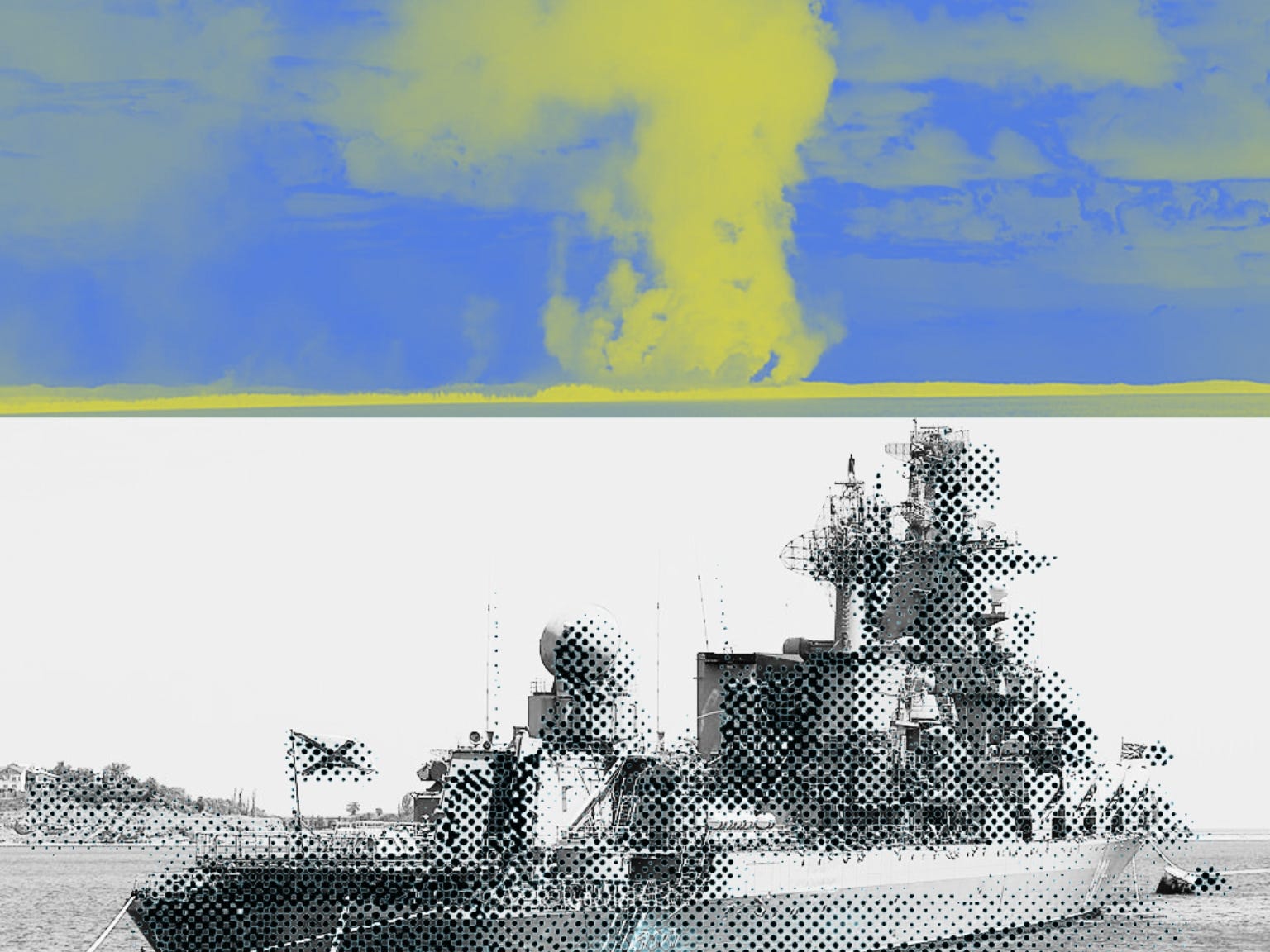
The Return of History
Stare at Central Europe in the 1850s for long enough and you will begin to see Central Europe in the 2020s. We find Russia hungry, a menacing, irredentist empire searching for territory and resources. We find Britain, France, and Turkey (that is, the Ottoman Empire) aligned. The Ottomans are a declining empire, struggling to keep the peace across the Middle East. East and West compete for control of the Holy Land, destabilizing the region. Russia argues that Orthodox Christians are being mistreated by the Turkic and Eurocentric anti-Russian bureaucrats West of the Danube, and attempts to subsume a vast swath of territory with military force. The Russians quickly become entrenched and lose their momentum; they are isolated from the global economy and their currency undergoes devaluation. The Allies introduce radical innovations in military technology. The Tsar’s coffers empty faster than expected. The war draws to a stalemate. Sounds familiar, doesn’t it?
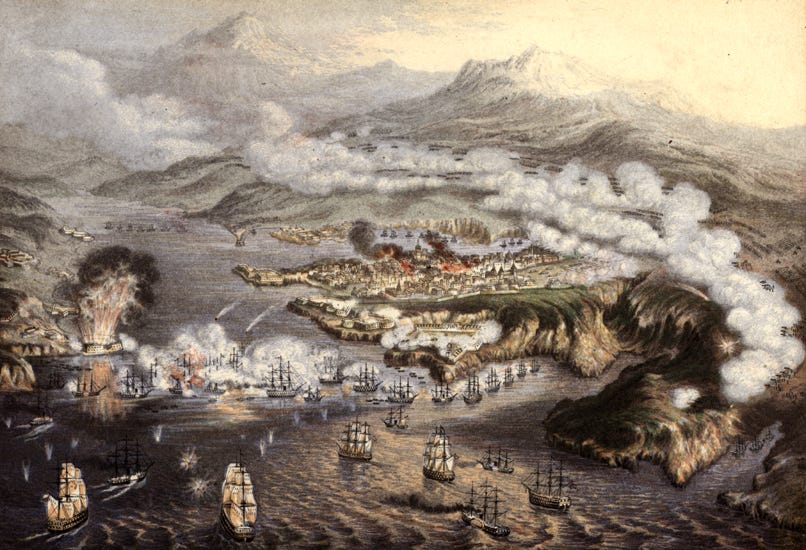
By 1854, it was clear that the war would be won by an overwhelming naval landing on Russian territory. Sevastopol was a natural choice for the offensive. It was home to the Tsar’s Black Sea Fleet, a powerful fleet of ships which threatened Mediterranean trade routes. It held a massive garrison of Russian troops ready to defend the south of the country from Austrian and Allied attacks. It gave the Tsar near-unrestricted access to the Bosporus and the Dardanelles, the two straits which allow ships to pass from the Black Sea to the Mediterranean, where they could dock in what is now Lebanon or Israel. Whoever controlled this small, reinforced city would control the entire Eastern Mediterranean. There was only ever going to be one ending: the breaking of Sevastopol, and the victory of the Allies.
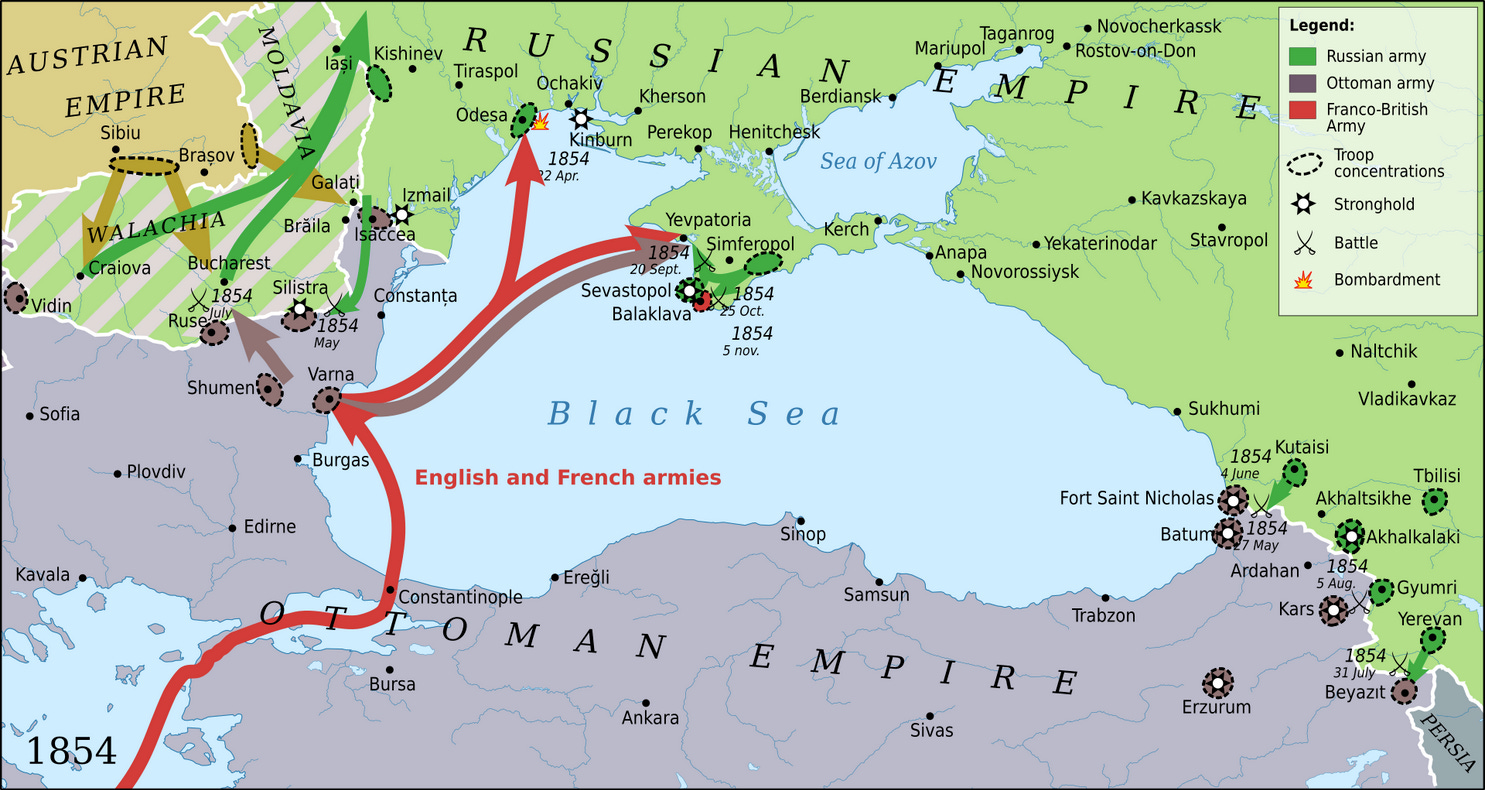
Sensing the incipient offensive, Leo Tolstoy, then 26 years old, requested a transfer from the Caucasus to the small, wet city of Sevastopol. He was hoping to see the landing up close.
“After traversing a couple of hundred paces, you emerge upon a muddy expanse, all ploughed up, and surrounded on all sides by gabions, earthworks, platforms, earth huts, upon which great cast-iron guns stand, and cannon-balls lie in symmetrical heaps… but everywhere, on all sides, in every spot, you see broken dishes, unexploded bombs, cannon-balls, signs of encampment, all sunk in the liquid, viscous mud.”
He arrived just in time. The Western coalition of allies (among them the French, Sardinian, Ottoman, and British armies) were preparing to land on the tip of the Crimean Peninsula, but not before softening the coast with an artillery bombardment.
“The shriek of a cannon-ball or a bomb close by surprises you unpleasantly, as you ascend the hill. You understand all at once, and quite differently from what you have before, the significance of those sounds of shots which you heard in the city.”
The massive multi-day bombardment was directed from the Allied ships against entrenched Russian positions. The indiscriminate fire killed and wounded soldiers and horses alike. Huddled under the defenses in the fifth bastion, Tolstoy became enamored with the sensation of siege.
“… but when the shot has flown past without touching you, you grow animated, and a certain cheerful, inexpressibly pleasant feeling overpowers you, but only for a moment, so that you discover a peculiar sort of charm in danger, in this game of life and death, you want cannon-balls or bombs to strike nearer to you.”
How very Russian. Perhaps it would amuse him that the Black Sea is on fire again, that Sevastopol is again the locus of the clash between Russia and the West, that the arc of history bends over the Black Sea.
To Ukrainians, however, there is no “peculiar sort of charm” in bombardment. For them, the modern-day battle of the Black Sea is a life-or-death struggle. In successfully surviving to a fifth year of war, they have not only altered the balance of power in the region, but altered naval warfare forever. Keep reading to find out how.
Snake Island: The Battle of the Black Sea, 2022-26
It begins as a normal night in the borderlands of the former Soviet Union. Guards stand smoking cigarettes at their posts. Pools of greasy sodium light are projected across borders, illuminating battered roads and tired sawhorses. Suddenly, Russian tanks and armed personnel carriers push across the line. They tear down barbed-wire fences, rappel from helicopters onto the plains of the Donbas, shoot the border guards and roll through the gates. From the streets of Kyiv to the breadbasket of Europe, Russia’s full-scale invasion of Ukraine has begun.
It has begun in the Black Sea, too. The conventional naval campaign against Ukraine can be characterized by four key phases: an attempted sealift by Russian forces, Ukraine’s opening of an air-to-sea defense umbrella, the 2023 grain detente, and the pivot to a long-term blockade.
I: Sealift
In the Black Sea, 25% of the world's grain is afloat.1 The cargo ships which carry it must quickly steam to safety, as Russian ships begin to pour out of Sevastopol, pushing though the night to open a new front in the war.
Immediately, patrol boats and artillery boats close the Sea of Azov, which lies between Russia and Crimea and serves as one of Russia’s gates to the Black Sea. The Russian navy deploys destroyers and battleships alongside troop carriers, ready to put Russian soldiers on the ground.
If they manage to land troops at Odesa, Russian naval planners believe, Kyiv will find itself in the center of a massive pincer movement. The war will be effectively over, a simple matter of time and manpower. But they have underestimated Ukrainian willpower.
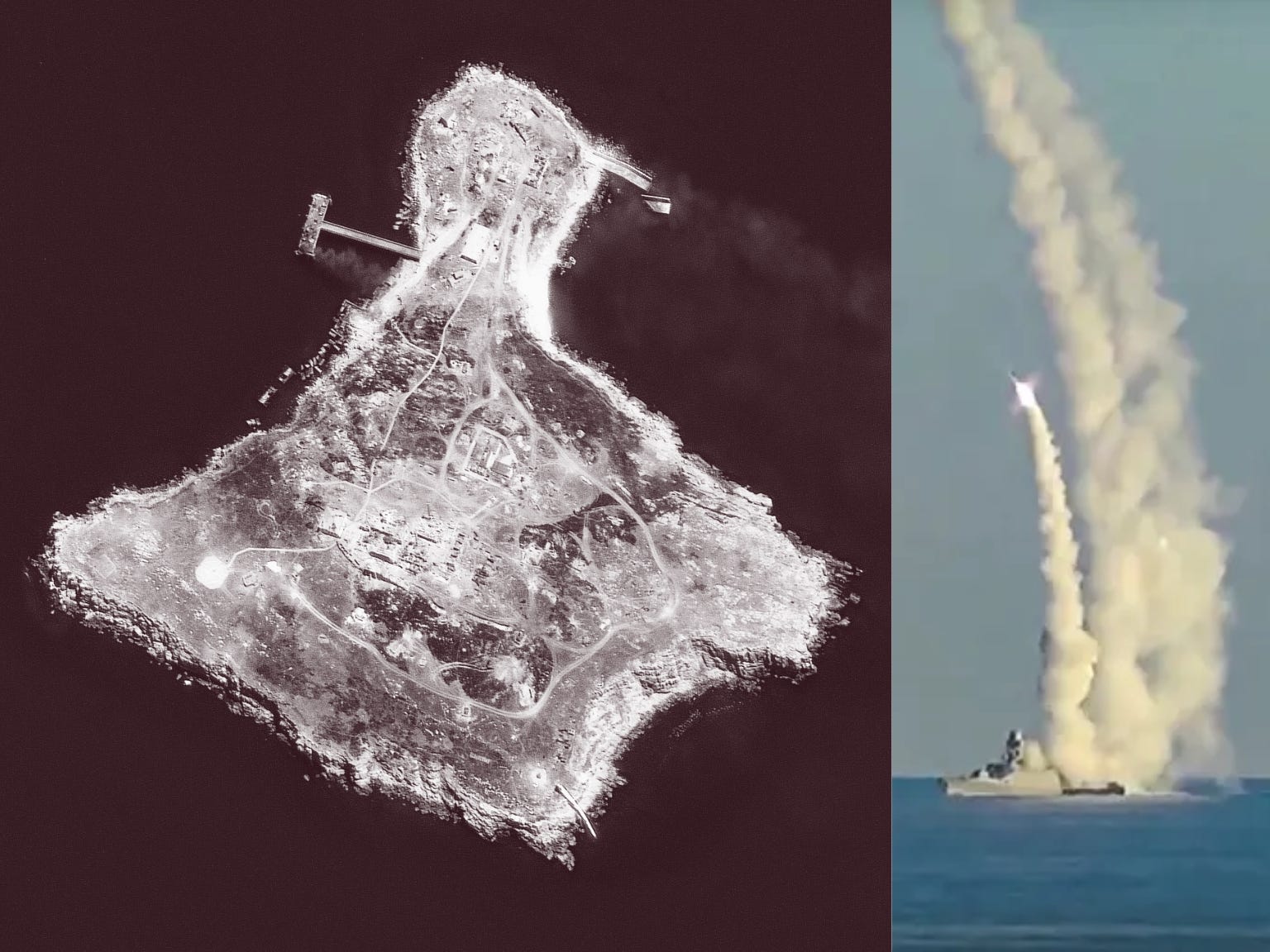
Ukraine has mined the area around Odesa, making a direct assault impossible.2 Further, Ukrainian forces outpace expectations in their defense of critical sites like Zmiinyi Island, or Snake Island.3 These small Black Sea islands are close to Ukraine’s shores and are extremely powerful, as they support air defense systems, radar and reconnaissance equipment, and allow for missile launches across the Sea.4 Though the Russian navy’s warship Moskva eventually takes the island, they suffer severe casualties, and Ukraine buys itself time to open its “defense umbrella”.
II: Umbrella
The “umbrella” refers to Ukrainian long-range anti-ship missile capabilities, which allow Ukrainian defenders to increase the threat range for Russian ships and drive them further from the coast. Shortly after the invasion, Ukraine receives5 the Harpoon anti-ship missile from the United States, and begins to deploy6 the radar-homing Neptune missile, both of which are designed to target and sink large conventional warships.
In April 2022, they use it to sink the 510-crew warship Moskva, delivering a painful blow to Russian morale.7 The Moskva was Putin’s flagship, the ultimate symbol of a revanchist Russia’s supposedly unstoppable power. After the sinking of the Moskva, it becomes clear that Russia’s attempted sealift was over.
III: Detente
By June 2022, with mounting naval losses and pressure abroad due to a growing international wheat shortage, Russia draws back its warships. As 56 million tons of wheat were waiting to be shipped through the Black Sea, resolving the shortage becomes a key priority for the UN.8
In July, Russia agreed to the Black Sea Grain Initiative with Ukraine: both sides would allow the export of grain through the Black Sea, and neither would attack cargo ships.9 This deal developed the precedent that cargo ships were off-limits: they were not to be struck, nor to be used for shipping weapons. Russia, however, did not intend to follow this regulation.
IV: Blockade and Evolution
In summer 2023, Russia asked that the sanctions on them be dissolved in exchange for their continued participation in the grain deal.10 When this demand is not met, they withdraw from the deal, and it collapses. After bombing granaries in Odesa, Russian naval forces begin to operate north of the Bosphorus Strait, attempting to block Ukrainian ships from accessing the West.11 With a Russian landing out of the question, and Ukraine’s navy too weak to expel them entirely, the Black Sea was in a stalemate.
Facing pressure from Western sanctions, Russia begins to assemble a large fleet of ships which sailed under other countries’ flags. Though flagged to countries like Panama, Liberia, and Gabon, these ships exclusively existed to sidestep Russian sanctions and illegally bring Russian goods out of the Black Sea. This is the origin of Russia’s sanction-busting Shadow Fleet.
Shadow Fleet
With increasing pressure to hide its vessels from Ukrainian attacks and disguise trade to evade sanctions, Russia’s Shadow Fleet of deniable ships has nearly tripled in size since 2023.12 It has expanded from an initial 600 to an estimated 1,400 vessels, with some estimates numbering as high as 1,649. Each one of these ships carries cargo worth millions of dollars, along with the lethal tools of war, including bullets, bombs, and drone components.
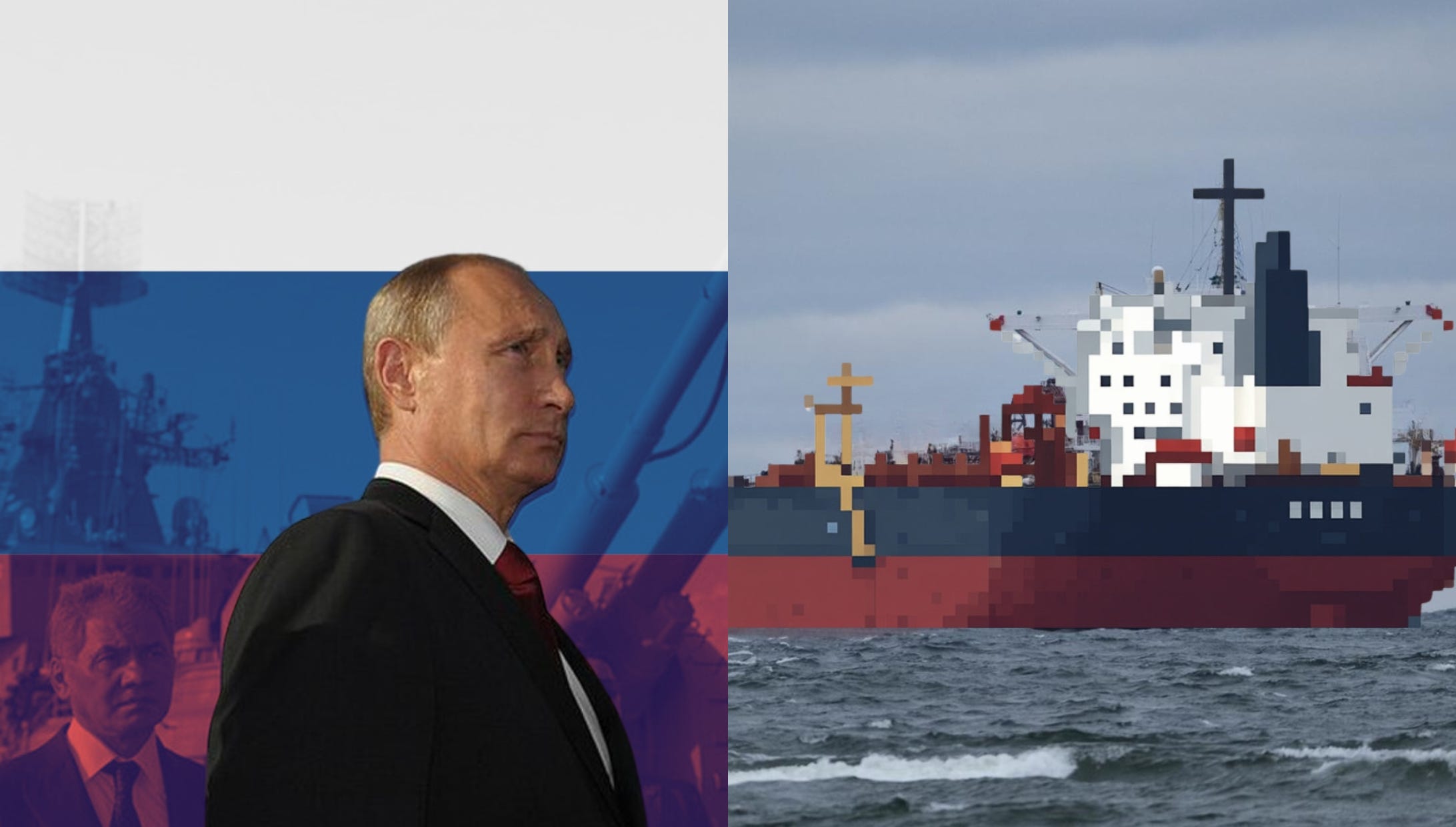
There are a number of indicators that suggest a given ship is a member of the Shadow Fleet. Most analysts agree that a member of the Shadow Fleet is more than twenty years old, registered to a country with less than five million people or no country at all, and is either underinsured or uninsured.13 It carries cargo, especially oil and other energy products, and often carries Russian weapons as well, which may be labeled as automotive goods or tractor components. A Shadow Fleet vessel changes flags regularly, turns its transponder on and off, and frequently transfers cargo with other vessels. Finally, it will often pass through the Black Sea, or docks on Russia’s Baltic coast.
The rapid growth of Gabon’s shipping industry helps illustrate the nature of the Shadow Fleet. This small African country, an ally of Russia, has seen its ship registry double since early 2023.14 Of that registry, only 2% of tankers have an identifiable owner or low-risk insurance status. Since a 2023 military coup, Gabon’s government has supported Russia.15 It is reasonable to assume that Gabon allows Russia to illegally use its shipping registry in exchange for a portion of Shadow Fleet revenue.
Ultimately, the Shadow Fleet exists to maintain Russian exports by circumventing the comprehensive Western sanctions, and to ship weapons across the Black Sea. For a time, the Fleet was untouchable; Ukrainian forces could not sink the ships without risking condemnation for attacking a non-combatant country’s vessel. International law would frown upon Ukraine attacking ships registered to Gabon, Liberia, or Panama. However, with increasing international recognition of the Shadow Fleet and its destructive effect on global maritime treaties, Ukraine has substantially more latitude to act. The United States and its allies are targeting and tracking the Shadow Fleet in order to extend Western sanctions, and it is reasonable to assume that intelligence on the Fleet is being shared with Ukraine.16
In late 2025, Sea Baby drones sank the Palau-flagged oil tanker Elbus, which was delivering oil to Russia.17 The Comoros-flagged Dashan, turned off its transponder as it approached the Russian port terminal of Novorossiysk; the deception, however, was not enough. A Sea Baby drone sailed up to the stern and detonated, critically damaging the ship. Off Turkey’s Black Sea coast, Sea Baby drones struck the Gambian-flagged Kairos and Virat.18 If they had been allowed to pass through the strait, the Russian oil they carried would have been passed off as Gambian product, and sold on the international market. The 70 million dollars in revenue from the sale would have flowed back to the Russian state, and directed towards the war on Ukraine.
Strategic modernization, however, was not Russia’s prerogative. The Ukrainian response to the Shadow Fleet has altered naval warfare. It is called Sea Baby.
Sea Baby
Shortly after the invasion, Ukrainian brigadier general Ivan V. Lukashevych proposed using unmanned vessels, or sea drones, to attack the Russian naval fleet.19 The drones would need to be many things: fast, mobile, reproducible, explosive, and cheap.
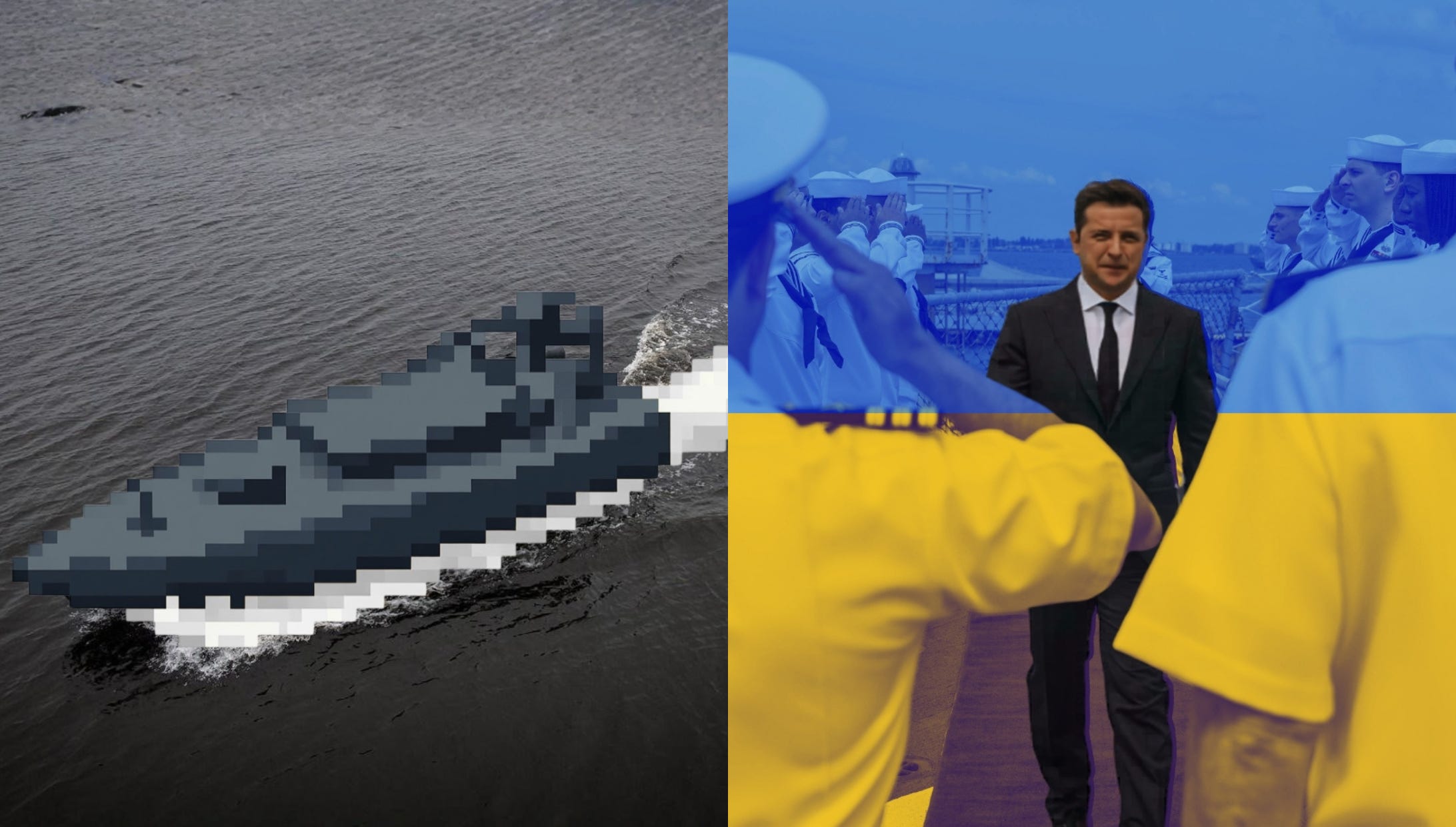
Ukrainian security services (SBU) tested their new devices in secret, eventually presenting director Vasyl Malyuk with a completed prototype. It was a small, sleek, grey vessel about six feet wide and twenty feet long, with internal space for communication equipment, fuel, and explosives. The unmanned naval vehicle was designed to be a jack of all trades and a master of funds: a cheap platform which could do almost everything at extremely low cost. The drone could lay mines, launch missiles and thermobaric rockets, or act as a floating bomb. (This last capability recalls the Iranian Shahed suicide drone, which I have written about here.)
In reference to their director’s last name, they whimsically named the drone mors’kyi malyuk, or Sea Baby. The name stuck.
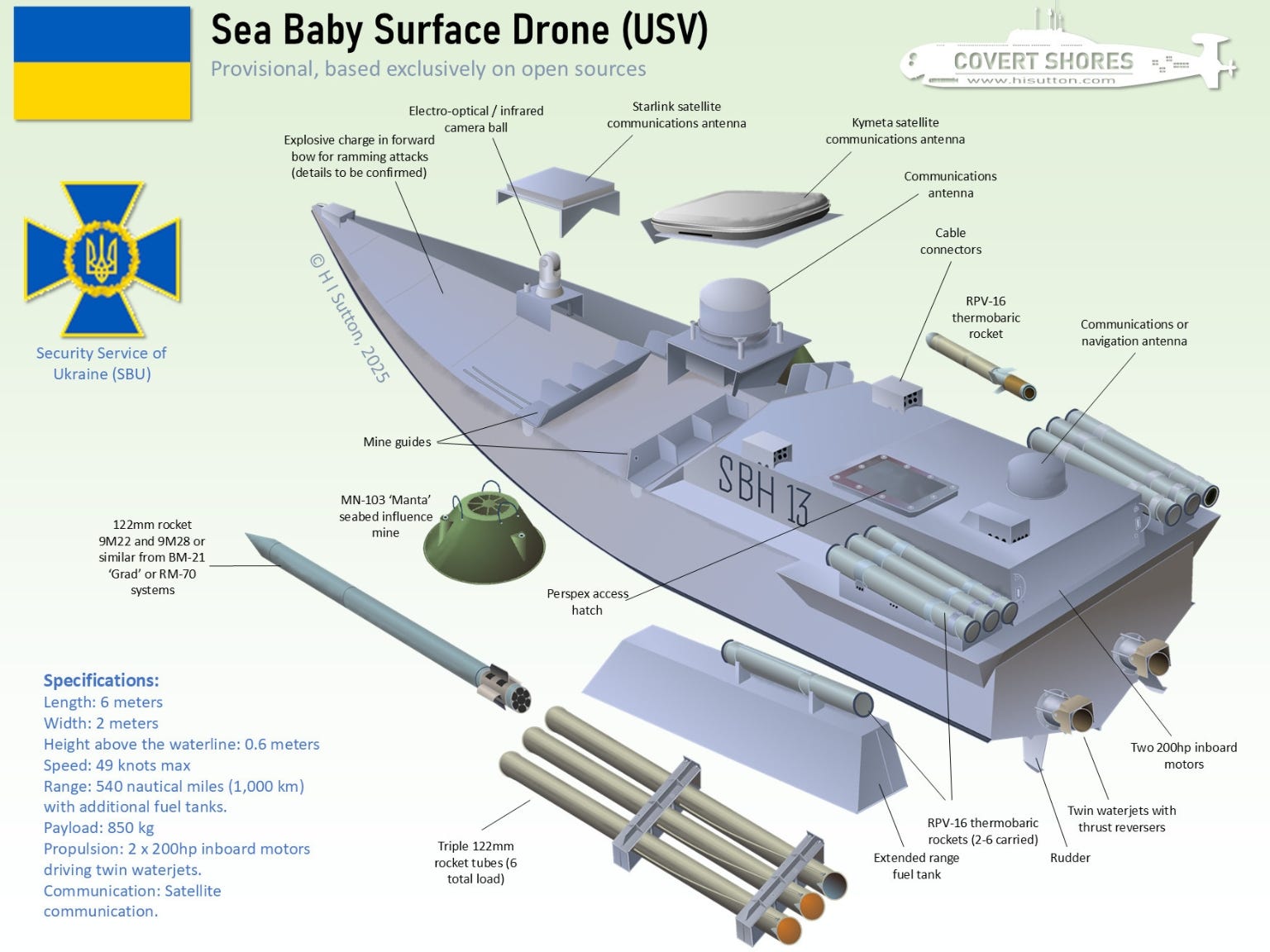
The Sea Baby was first used to attack the Kerch Bridge in summer 2023, which connects Russian-controlled Crimea to conflict zones in Southeast Ukraine.20 The drones were configured to sail around Russian convoys and through areas with little to no Russian detection equipment. They evaded gunfire from Russian guards, sailing up to the bridge and detonating their payloads against the concrete pillars. The road buckled and a segment collapsed; Russian troops were unable to cross the bridge for weeks.
Over the next year and a half, Sea Baby drones struck the Russian corvette Samum, the patrol ship Pavel Derzhavin, and the reconnaissance and hydrographic ship Vladimir Kozitsky. Then a Sea Baby autonomously launched an R-73 infrared missile against a Ka-29 helicopter. Fearing the Sea Baby drones, Russia began installing nets and buoys at its naval bases. When a storm washed those defenses away, Ukrainian operators mounted machine guns on the drones and hit the bases with a barrage of fire.
The Sea Baby is particularly effective at destroying oil tankers. The Shadow Fleet’s tankers are easy prey. Consider the Dashan, a Russian tanker valued at approximately $30 million USD. On a single voyage it can carry up to $60 million USD of oil. The tanker has been targeted by multiple international sanctions, including measures imposed by Ukraine, the European Union, the United Kingdom, Canada, Australia and Switzerland. And in December of 2025, a $221,000 USD Sea Baby sent it plunging to the bottom of the Sea. The video below, recorded by a camera mounted on a Sea Baby, depicts the moment the Dashan was struck.
It is apparent that these cheap and reproducible systems used by Ukraine are also variable and effective. They can carry explosives to a target or launch missiles from sea to air; they can be rapidly deployed to take advantage of weather conditions or political developments. Their power to move in groups, far from their operators, is substantial. They defray the human and monetary cost of naval activity, and support unprecedented levels of modification and experimentation. They make clear that unmanned warfare is likely to be the future of naval conflict.
State Size and Naval Power
As we have seen, Russia and Ukraine have developed two radically different approaches to modern naval warfare. These two approaches will determine the outlook for naval defense for decades to come.
The first is the outlook for small states, and medium-sized states like Ukraine. Naval defense is cheaper and more affordable than ever before. Autonomy is key to this success, so any advances in artificial intelligence are also advances in defense. A strong but nimble defense-industrial base which can rapidly produce modifications on modular systems is absolutely essential, and purchases of massive warships and cruises are no longer as financially sound or necessary as they were a decade ago. Why invest millions into an exquisite system that can be destroyed in seconds when a mere percentage of that cost could be used to build waves of drones that overwhelm by sheer force of numbers, and can more easily respond to evolving conditions in the battle space?
This should be of particular interest to small, embattled players like Taiwan and South Korea, who continue to invest large volumes of their defense budget in exquisite systems. Any coherent small-state defense strategy needs these weapons, and most likely requires them at a larger scale than the attacking state can produce.
Then there is the outlook for large states like Russia. First, large states will need to leverage their defense industrial bases to create autonomous vessels. The large exquisite systems that they already own, like warships and aircraft carriers, must be integrated alongside autonomous vessels. While small states use drones to attack capabilities, large states may find great success using drones as escorts designed to self-sacrifice, absorbing hits that would otherwise sink larger, more powerful investments.
It is reasonable to assume that the dissemination, reproducibility, and affordability of drone technology will increase the likelihood of naval proxy wars across the globe. Of particular concern are the Gulf of Aden and the Strait of Hormuz. If Iran were to provide naval drone capacities to the Houthis, the Gulf of Aden could rapidly become impassibly risky and expensive for Western cargo ships. In such a world, the Strait of Hormuz could regularly be shut down by the Iranian Revolutionary Guard Corps without substantial risks to the Iranian navy. Of greatest concern is the East China Sea and the South China Sea. Territories like the Spratly and Senkaku islands, which are only marginally livable but essential to naval resupply routes, could easily be defended by swarms of inexpensive naval drones.
While some analysts argue that sea drones are powerful for defense but useless without larger naval systems, this thinking betrays a lack of imagination. While a single sea drone certainly cannot execute a blockade on its own, rapid advancements in autonomous steering and communication systems will soon allow these vessels to coordinate and swarm targets, making it possible for them to operate with little or no human assistance.
In this more hostile world, large states will inevitably come to rely on the deceptive techniques which Russia has used extensively in the Black Sea. American, Chinese, and Russian vessels would operate through chains of offshore owners; certain regions would become grey zones with minimal regulation, and in those zones the use of basic communication and identification systems would fall apart.
If, for instance, China was to blockade Taiwan in an attempt to force a reunification, they would almost certainly use a shadow fleet. They would surround the island with a mix of naval warships, coast guard patrols, unmarked boats, and a flotilla of domestic- and foreign-flagged civilian vessels, as recent exercises have demonstrated.21 This mixed-use fleet would confuse the international community. This technique would make it more difficult, if not impossible, to organize allies to send supplies to Taiwan. Simply put, shadow fleets are not going away. And the Chinese shadow fleet may already be well-developed: this winter, a Chinese-flagged civilian container vessel was spotted carrying a missile system disguised as a normal shipping container.22
Finishing the Job
These evolutions in naval strategy have upended the war in Ukraine and the shape for naval wars to come, but the question remains: who will win the Black Sea?
One school of thought suggests that, absent a greatly intensified Western posture in the Black Sea, Russia will be victorious. Most of the Shadow Fleet remains in service; as the War in Ukraine stretches on, they may innovate counter-drone solutions to support said fleet. They may rely on electronic warfare to disrupt and neutralize drone guidance systems, or carry out constant coastline patrols with surface-detonating munitions. Russia may create semi-autonomous drone bases in Crimea, or in coastal Abkhazia, Georgia’s Russian-backed breakaway region. They may even surround the Shadow Fleet or their major warships with a buffer zone of drones, designed to sacrifice themselves and protect the attacked vessel.
The taking of the Black Sea would severely weaken Ukraine’s ability to defend itself. A naval landing at or northeast of Odesa would irrevocably disrupt Ukrainian supply lines, making the eastern Fortress Belt impossible to hold. Kyiv would fall shortly thereafter. This end to the war would fundamentally reshape the balance of power among Eastern European countries like Romania, and Mediterranean states like Greece and Turkey. These states would become more militarized, as NATO would no longer have a buffer zone between itself and Russia. Furthermore, Russia would probably claim the Black Sea as its own exclusive territory, a claim Turkey would reject, making the Dardanelles and the Bosphorus some of the most hotly contested naval areas on Earth. If Russia’s imperial goals for the Black Sea were to be realized, global supply chains would be forever altered; their control over Eurasia would be almost limitless.
A second school of thought holds that Ukraine will utilize its sea drone capabilities to disrupt Russian shipping lines and bleed the aggressor of oil and funds. Like the rest of their war, it will be fought by attrition. The only way to guarantee success is to continue innovating the Sea Baby and other autonomous naval systems, and to continually expand the power and security of the defense-industrial base. Though this future will clearly be characterized by a naval-drone arm’s race, it’s not clear who would exercise control over the Black Sea if a settlement or treaty was reached. Grimly, it’s possible that low-level naval drone attacks may become an undeniable reality in the Black Sea for decades post-war.
The Return of History (Cont.)
And what about the first Battle of the Black Sea, from the Crimean War? How did that one end?
The siege which so thrilled and disturbed Tolstoy ultimately succeeded in breaking Russia’s resolve. After heavy casualties, the Russians withdrew from Sevastopol, escaping a total encirclement and effectively ending the Crimean War.
“… yes, white flags are hung out from the bastion and the trenches, the flowery vale is filled with dead bodies, the splendid sun sinks into the blue sea, and the blue sea undulates and glitters in the golden rays of the sun…”
Sevastopol is remembered as one of the last true sieges in history. It opened the Tsar’s empire to nearly unrestricted attack from the West, and pushed the country closer to economic and land reform, namely the abolition of serfdom. (This reform preceded and empowered the burgeoning Russian Revolution.) The siege revolutionized battlefield medicine, laid bare the importance of supply chains, and established defensive trenches and massive artillery bombardments as the warfare of the future. In this regard, it prefigures WW1, and much of the century that followed.
As early as 1954, Soviet authorities recognized that the city was caught between the Russian and Ukrainian socialist republics (SSR). It was transferred that year to the Ukrainian SSR, but Russian military figures continued to argue for its Russianness. It even hosted the USSR’s Black Sea navy, which in 1991 was split between the fledgling nations of Ukraine and Russia, while the port of Sevastopol was to be shared by both countries. But this was an imperial compromise: the coast of the Black Sea is Ukrainian in culture, language, and nationality, and autonomous in character23. Sevastopol may have been the Tsarist army’s last stand, but Black Sea is not a Russian lake, and it never will be.
All this to say: the Black Sea will not see peace until Russia decides that it loves its own homeland more than it hungers for Ukraine’s.
Or as Tolstoy put it:
“Thousands of men have been disappointed in satisfying their ambition… thousands repose in the embrace of death…”
“… and the question, unsolved by the diplomats, has still not been solved by powder and blood.”
***
https://www.csis.org/analysis/maritime-domain-lessons-russia-ukraine-conflict-focus
https://www.cnbc.com/2022/06/10/russia-and-ukraine-battle-over-underwater-mines-in-the-black-sea.html
https://cepa.org/comprehensive-reports/the-strategic-importance-of-snake-island/
https://cepa.org/comprehensive-reports/the-strategic-importance-of-snake-island/
https://www.reuters.com/world/europe/ukraine-receives-harpoon-missiles-howitzers-says-defence-minister-2022-05-28/
https://www.twz.com/land/ukraines-long-neptune-cruise-missile-seen-in-action-for-the-first-time
https://www.bbc.com/news/world-europe-61103927
https://www.intereconomics.eu/contents/year/2022/number/3/article/the-war-in-ukraine-agricultural-trade-and-risks-to-global-food-security.html
https://www.csis.org/analysis/maritime-domain-lessons-russia-ukraine-conflict-focus
https://www.theguardian.com/world/2023/jul/20/what-was-the-black-sea-grain-deal-and-why-did-it-collapse
https://www.bbc.com/news/world-europe-66242446
https://www.atlanticcouncil.org/in-depth-research-reports/issue-brief/russias-growing-dark-fleet-risks-for-the-global-maritime-order/
https://www.atlanticcouncil.org/in-depth-research-reports/issue-brief/russias-growing-dark-fleet-risks-for-the-global-maritime-order/
https://splash247.com/shadow-fleet-shines-light-on-fast-growing-gabon-ship-registry/
https://www.nytimes.com/2024/10/03/world/europe/russian-oil-tankers-gabon.html
https://www.wsj.com/business/energy-oil/the-u-s-is-hunting-the-shadow-fleet-this-is-what-its-up-against-0feba9bb?gaa_at=eafs&gaa_n=AWEtsqdH9FWWOEdY8oFcdeWRHp1VqOCrQSKMRidhJDQI-MrxXuzc_6iXuYnJ1tonFc0%3D&gaa_ts=699b27cb&gaa_sig=lZElrl1U-IMk5LIyM7DpmtDHBMHFPtfA1ypyIMhQFYArEY7tAvzXZANRAT_mw_QvDQE8Ycis03q3ThTb62t5bQ%3D%3D
https://www.navalnews.com/naval-news/2026/01/ukraine-hits-another-shadow-fleet-tanker-off-turkish-coast/
https://kyivindependent.com/ukrainian-naval-drones-behind-successful-strike-on-2-russian-shadow-fleet-tankers/
https://www.pravda.com.ua/eng/articles/2024/01/01/7435326/
https://meduza.io/en/feature/2023/07/17/the-same-ones-were-used-on-sevastopol-three-months-ago
https://www.csis.org/analysis/signals-swarm-data-behind-chinas-maritime-gray-zone-campaign-near-taiwan
https://www.navalnews.com/naval-news/2025/12/container-ship-turned-missile-battery-spotted-in-china/
https://link.springer.com/article/10.1007/s11185-022-09264-7